New RF demands in drone communications
The rapid evolution of communication standards, driven by the arrival of NTN (Non Terrestrial Networks), is placing unprecedented pressure on the radio frequency (RF) architectures of unmanned systems. In the field of defense and telecommunications drones, market needs are converging toward three critical imperatives:
- Increased transmission range (beyond visual line of sight, or BVLOS)
- Absolute reliability in contested environments
- Srengthened data security
To meet these challenges, optimizing isolated components is no longer enough. It is now crucial to guarantee the « cleanliness » of the entire signal chain. The adoption of advanced linearization techniques not only enables massive data rates with ultra-low latency but also optimizes the SWaP-C (Size, Weight, Power, and Cost) ratio.
By reducing energy consumption and improving the efficiency of the communication system, we enable drones to carry lighter batteries or increase their flight time.
New market demands = new challenges
Traditional radio chains are currently hitting a « physical wall » when faced with the requirements of current drone missions. While the market demands longer range and higher throughput, the non-linear behavior of analog Power Amplifiers (PAs) creates a major bottleneck. In high-stakes environments like defense, intelligence-surveillance-recognition (or ISR), or critical telecommunications, these non-linearities lead to signal distortion (EVM degradation) and spectral regrowth (ACLR issues), which directly translate into dropped connections, reduced range, and increased vulnerability to detection.
To overcome these limitations , WUPATEC masters the convergence of digital & analog RF circuits. By leveraging our knowledge in the latest generation of high power efficiency architectures, we implement advanced data management techniques that « clean » the signal before it even reaches the antenna.
This continuous digital-analog interaction allows us to push low-cost or high-efficiency communication system far beyond their standard limits. For a drone operator, this means maintaining a robust 4K video link or encrypted command-and-control (C2) at distances where traditional systems would fail.
By solving analog challenges with digital intelligence, we deliver a SWaP-C optimized solution that guarantees reliability under all atmospheric and operational conditions.
What is our specific offering to solve these challenges?
To overcome the physical barriers of the traditional RF chain, Wupatec does not act as a simple component supplier but as an architect of digital-analog convergence.
Expertise at the heart of the RF Chain
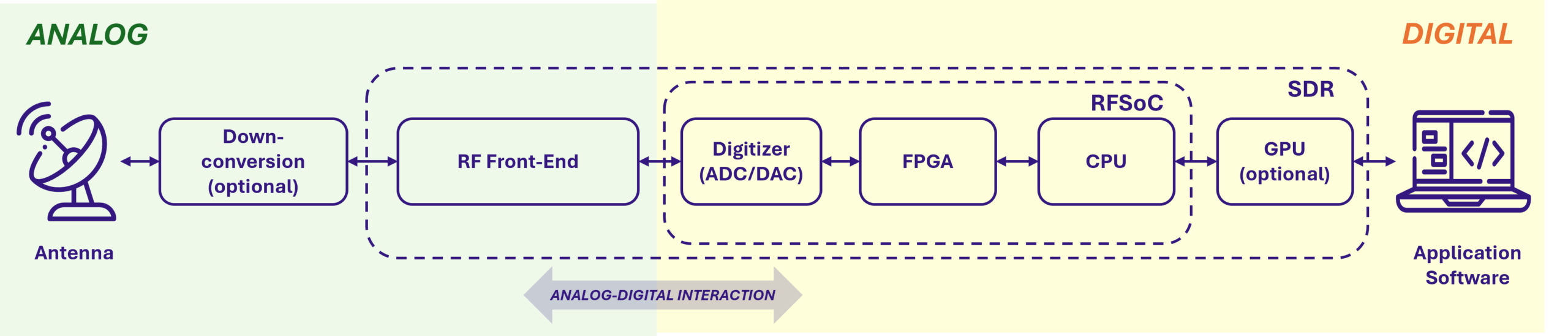
Inside a typical RF front-end (see diagram below), the overall performance is often limited by two key elements
- The power amplifier (PA), which largely determines the overall system efficiency
- The interaction between the analog and digital sections.
This is precisely where Wupatec delivers a distinctive value, by optimizing the design of the power amplifier and the entire analog RF chain and avoiding oversizing of the digital control, thanks to a perfect knowledge of the nonlinearities and memory effects of the power circuit.
When modulated signals are provided (the type of data transmitted or received in wireless communications), a well-defined digital section ensures smooth integration between signal processing and the physical behavior of the RF components, enabling a highly efficient communication system that responds to the requested use case.
on a notre propre algo et on sait utiliser on utilise ceux des concurrents du commerce
Our specific areas of expertise:
- Advanced Linearization Algorithms: our in-house algorithms (digital pre-distortion (DPD) and crest factor reduction (CFR)) are used to improve power amplifier efficiency, reduce signal distortion, and maximize spectral efficiency. This enables longer system autonomy, more reliable communication links, and optimized performance in bandwidth-constrained or interference-heavy environments.
- RF Designs: Our team has rare expertise in designing complex power amplifier architectures for the RF frontend, such as Doherty topologies, which significantly improve overall power efficiency.
- Power Management via Envelope Tracking (ET): Leveraging our patented technology for maximum system efficiency, we dynamically adjust the PA supply voltage according to the signal. This technology is the ultimate lever for increasing system efficiency and reducing heat dissipation.

WFC725A transceivers for 5G/6G communications
Our communication modules are designed for the demands of next-generation wireless platforms. A prime example is our recently released 5G/6G transceiver (transmitter-receiver) (WFC725A), which is specifically designed to address the emerging requirements of the wireless markets, both for terrestrial (TN) and non-terrestrial networks (NTN).
While traditional solutions often limit operators to narrow bands, our module provides significant flexibility by covering the entire spectrum from 10 MHz to the beginning of the mmWave range (25.8 GHz). With a focus on a low SWaP-C (size, weight, power, and cost) architecture, it supports high-bandwidth, long-range links while helping preserve flight endurance and payload capacity.
Unlike standard solutions, the WFC725A provides a robust, integrated solution that accelerates time-to-market for mission-critical aerospace applications.
| Other Solutions | Wupatec’s Solution | Why is this relevant | |
|---|---|---|---|
| Full Frequency Coverage | Limited (tipically 6-18 GHz) | Ultra-wide: From 10 MHz to 25.8 GHz | Flexibility of utilisation of different bands for different applications (radar, 5G/6G communications, etc.) |
| Operating Mode | TDD only | Full Versatility (FDD/TDD compatible) | TDD: Transmit and receive in alternating time slots. FDD: Transmit and receive continuously at the same time |
| Integration level | In some cases, the LO is not integrated and requires external RF sources | LO integrated | Need to add external blocks that impacts the SWAP characteristics and complexity of the system |
| Instantaneous Bandwidth (iBW) | Limited to 1 GHz (due to external circuits) | 1.2 GHz, high performance across full range | Greater iBW equals to faster data throughput and superior signal resolution by allowing the simultaneous processing of wider frequency ranges |
| Physical durability | Bare board; fragile and prone to damage | Robust, integrated design | Time-to market reduced to integrate it in a payload |
| Customer support | Often slow or impersonal corporate support | Agile & dedicated technical partnership | Personalized attention to the customer |
A deeper look in the RF signal management
One relevant feature of the WFC725A (that applies to all Wupatec’s communication modules) is the strategic optimization of Intermediate Frequency (IF) selection. In the transmit path, the baseband signal is interpolated and shifted to an IF via a Digital Upconverter (DUC), followed by bandpass filtering to suppress DAC images. The signal is then upconverted to the FR3 band using an IQ modulator. By utilizing a sufficiently high IF, unwanted components such as RF images and LO leakage are positioned far from the signal bandwidth, allowing for efficient filtering. This architectural advantage would be lost if a lower IF were used, as shown in the diagram below:
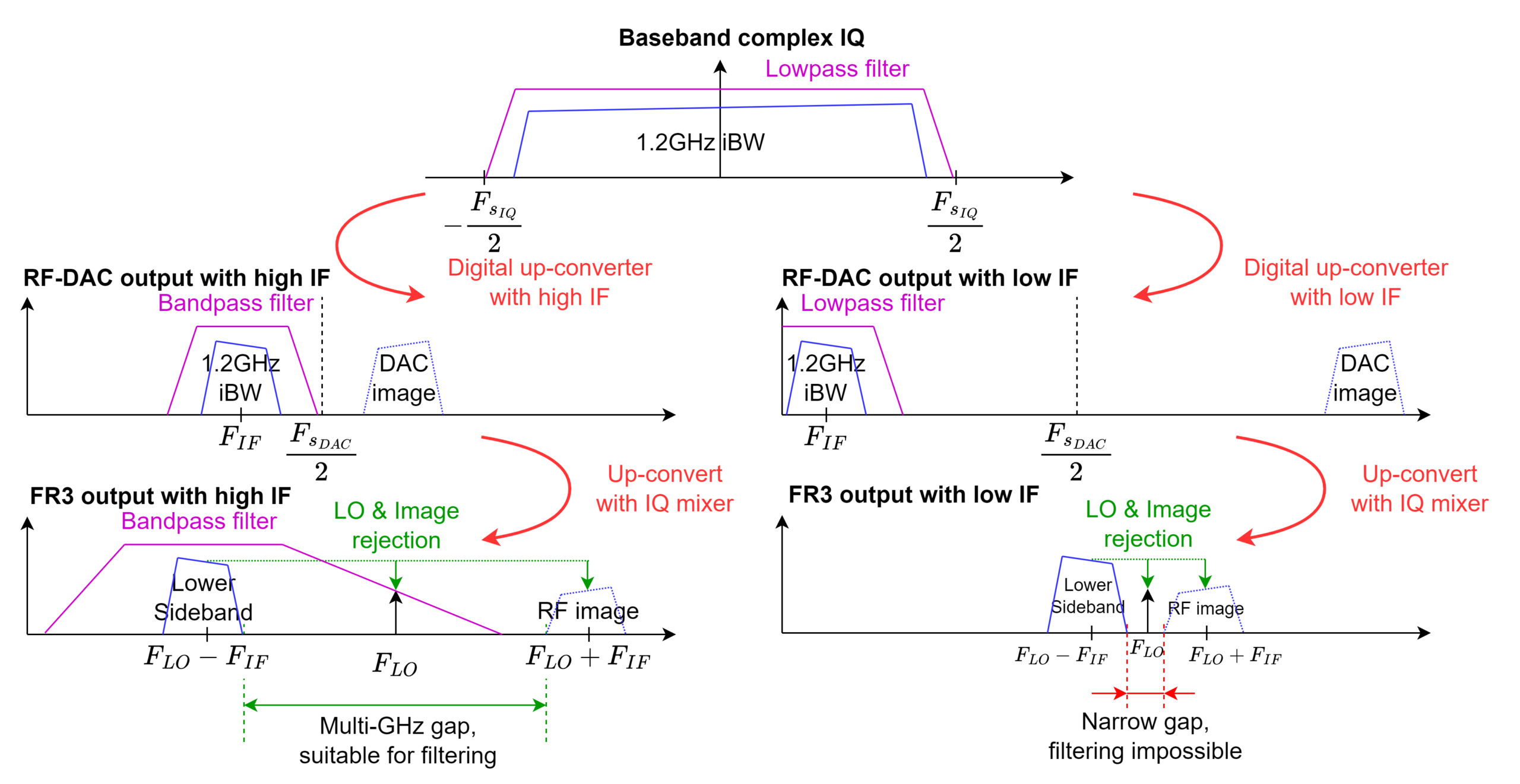
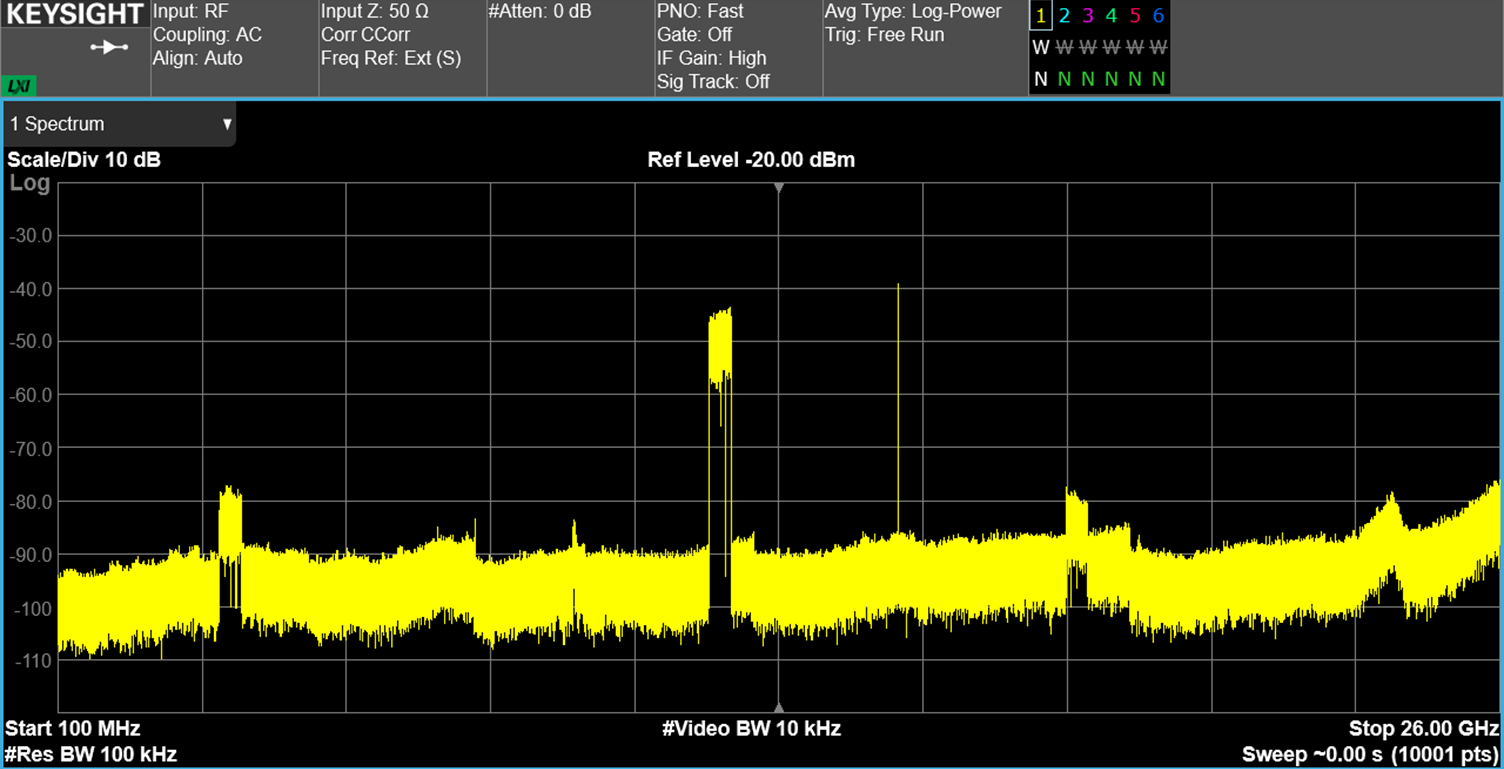
By utilizing a high IF, unwanted components such as DAC images, RF images, and LO leakage are positioned far from the signal bandwidth (see the spectrum image below of the transmit path). This spectral ‘breathing room’ enables highly efficient filtering, ensuring a clean and compliant spectrum across the entire 10 MHz to 25.8 GHz range.
The spectrum screenshot below represents the transmit path. Different signals can be identified: In the center, the transmission frequency. Moving to the right side, there is first a subtle leak signal coming out of the local oscillator and second, with lower amplitude, the image frequency. These two signals are far away from the center frequency of transmission (each square of the spectrum display is equal to 2.6 GHz). On the right side of the center frequency, there is a small leak of the IF input towards the RF output, again, far away from the center frequency. This is the reason why using a high IF gives this ‘breathing room’ for filtering.
By the way, this work was presented during the WSJ Workshop Session during the International Microwave Symposium in 2025. Check the related article on Microwave Journal here!
Benefits to UAVs and HAPS
All this directly translates to the following benefits:
Cleaner Transmissions: High IF selection means fewer interference issues, which is critical when operating in the crowded radio environments of UAV swarms.
Reduced Ground Footprint: Because we handle LO generation and complex filtering internally, you don’t need a rack of lab equipment (signal generators, external combiners) to get your system in the air.
Faster time-to-market for custom applications: This module serves as a solid foundation for any project. By adapting its robust functional base to specific requirements, you significantly accelerate the development of bespoke solutions.
Conclusion: Partnering for the NTN era
As the drone industry pivots toward beyond-visual-line-of-sight (BVLOS) operations and global connectivity via Non-Terrestrial Networks (NTN), the bottleneck is no longer just the airframe but the efficiency and reliability of the RF communication link.
Partnering with Wupatec represents a strategic move to address the critical SWaP-C (Size, Weight, Power, and Cost) challenges inherent in drone-to-satellite and drone-to-HAPS links. By integrating Wupatec’s advanced RF Front-End solutions, leveraging their unique expertise in GaN efficiency and Digital Pre-Distortion (DPD), organizations can significantly extend flight autonomy and ensure high-bandwidth data transmission even in the most demanding 5G/6G NTN environments.
In a landscape where energy efficiency is synonymous with mission success, Wupatec serves as the essential technological bridge, enabling partners to lead the transition from terrestrial dependency to truly ubiquitous, high-performance aerial connectivity.
Why Wupatec?
Field-Tested Knowledge
Mission-Centric Efficiency
Collaborative Innovation
In case you missed it…
OUR SOLUTIONS
Combined efforts that ensure first-pass success
Wupatec’s two pillars reside in its strong digital and analog knowledge. By having expertise in both fields, RF and digital, we ensure a transparent integration, and problematic behaviors can be anticipated during the design phase. Let’s work together.




Contact us
 +33 05 55 42 62 44
 Head Office: 20 rue Atlantis, 87068, Limoges, France