
Success story
Wupatec in ALMA: Atacama Large Millimeter/submillimeter Array
When engineering meets the cosmos: the story behind ALMA and WUPATEC’s contribution

by Irene de Gruijter
December 3, 2025, in Success Stories
High in the Chilean Andes, at 5,000 meters above sea level, a bold idea took shape: building a giant “cosmic eye” capable of capturing the faintest whispers of the universe: cold molecular clouds, newborn stars, and distant galaxies from the early cosmos. That idea became ALMA, the Atacama Large Millimeter/Submillimeter Array, one of the most powerful radio telescopes ever built.
But to turn all this into scientific data, the antennas alone weren’t enough. Deep inside ALMA’s cryogenic systems, every signal received must pass through an extremely delicate chain of RF components. This is where WUPATEC and its partner AMCAD stepped in: combining RF, analog, and digital expertise to solve one of the project’s most demanding engineering challenges.
For the technical version of the story, click here.
The challenge: preserving the universe’s most fragile signals
When an ALMA antenna captures radiation from space, it arrives not as visible light but as millimeter- and submillimeter-wave signals, spanning roughly 30 GHz to nearly 1 THz. These signals are astonishingly weak. Before scientists can analyze them, they must be down-converted to an Intermediate Frequency (IF) band from 0–20 GHz, without losing the physical meaning encoded in the original waveform.
That is where the real engineering challenge begins:
Ensuring an ultra-low noise figure, because any additional noise masks the very signals astronomers want to measure.
Maintaining a flat frequency response with minimal ripple, especially across wide bandwidths.
Keeping enough headroom to avoid compression or saturation across varying signal conditions.
Accounting for every practical detail: cable losses, connector mismatches, PCB variations, temperature effects… all the “small things” that become critical at these frequencies.
Meeting ALMA’s specifications meant understanding not just isolated blocks, but the behaviour of the entire cascaded chain as a system.
How WUPATEC and AMCAD rose to the challenge
WUPATEC and AMCAD teamed up to support the design and simulation of key elements of the intermediate-frequency (IF) reception chain. This chain forms part of the signal path that begins in outer space, is captured by the antennas, and travels all the way to the analog-to-digital conversion stage. The different stages of the project were:
1. A Custom Anti-Aliasing Filter
A dedicated AA filter was provided to ensure the IF signal remained clean and free from out-of-band artifacts that could compromise digitisation and later processing.
2. Full-Chain Simulation
Instead of treating each block independently, the team simulated the complete chain:
cascaded noise figure
gain distribution
compression (P1dB)
ripple and group delay
PCB and connector contributions
cable and interconnect losses
This holistic approach revealed how small mismatches or ripple could accumulate across the chain and how to fix them before hardware was built.
3. Architecture Optimisation & Final Report
By refining the gain staging, filter characteristics, interface losses, and dynamic range, the team delivered an architecture that met ALMA’s stringent requirements while ensuring long-term stability and reliability.
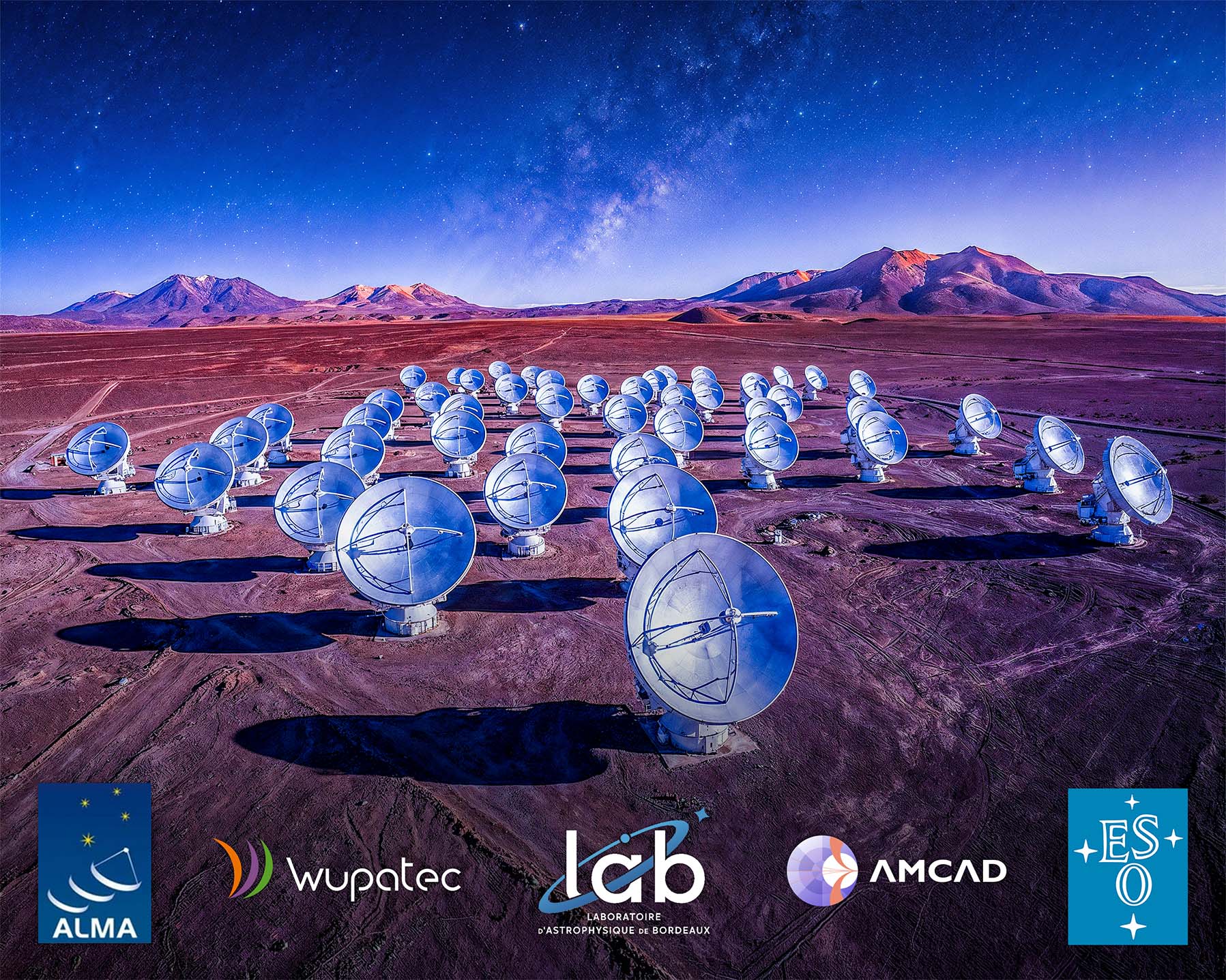
ALMA: a global scientific effort
ALMA is more than a telescope: it is one of the largest scientific collaborations between Europe, North America, Asia, and Chile, with more than $1.4 billion invested.
Within such a massive project, the role of specialized engineering teams is vital. The ALMA project illustrates what happens when engineering precision meets astronomical ambition. By applying rigorous RF simulation, system-level analysis, and careful optimisation, WUPATEC and AMCAD helped build an IF signal chain capable of supporting one of the most advanced observatories in the world.
For engineers who work daily with amplifiers, mixers, FPGAs, GaN devices, filters, and RF front-end design, this project is a reminder of something simple but powerful:
When technology is pushed to its limits and when teams collaborate across disciplines, we get closer not only to the desired results, but also to understanding the universe itself.
“ALMA — In Search of our Cosmic Origins” is a 16-minute film tracing the development of the ALMA observatory, from its early conception to its first scientific achievements. Featuring striking aerial footage, it takes viewers to the 5000-meter-high Chajnantor Plateau in Chile’s Atacama Desert, where the array is located.
Credit: ALMA (ESO/NAOJ/NRAO)