
CFR and DPD for Doherty Power Amplifiers
Learn how Crest Factor Reduction and Digital Pre-Distortion help improve efficiency and preserve linearity in Doherty Power Amplifiers for 4G/5G RF systems.

by Léa Chazalon and Bethel Anya
June 29, 2026 in News
Modern wireless systems, such as 4G and 5G base transceiver stations, transmit signals that are fast, wideband and composed of multiple subcarriers using OFDM. These signals create a major challenge for RF Power Amplifiers: a high Peak-to-Average Power Ratio, also known as PAPR.
In simple terms, the signal does not stay at a constant power level. It contains occasional high peaks that can push the amplifier into a nonlinear operating region.
For RF engineers, this creates a difficult compromise. If the Power Amplifier is operated with more back-off, linearity improves, but efficiency decreases. If the amplifier is driven closer to saturation to improve efficiency, nonlinear distortion becomes more critical.
This is why Crest Factor Reduction and Digital Pre-Distortion are commonly used together in modern RF systems. CFR helps reduce the signal peaks before amplification. DPD helps compensate for the nonlinear behavior of the amplifier.
Together, they help Doherty Power Amplifiers achieve a better balance between efficiency and linearity.
Key concepts before diving into CFR and DPD
Before looking at how CFR and DPD work, it is useful to clarify a few terms that often appear when discussing RF Power Amplifier linearization.
1. PAPR (Peak-to-Average Power Ratio), describes the difference between the peak power of a signal and its average power. A high-PAPR signal contains occasional peaks that are much higher than its average level, which makes amplification more difficult.
2. Back-off refers to the fact that a Power Amplifier is operated below its maximum output power. This helps preserve linearity, because the amplifier stays away from regions where distortion becomes more critical. However, this also reduces efficiency, because less of the consumed power is converted into useful RF output power.
3. CFR (Crest Factor Reduction), is a baseband signal processing technique used to reduce the PAPR of a transmitted signal before it reaches the Power Amplifier.
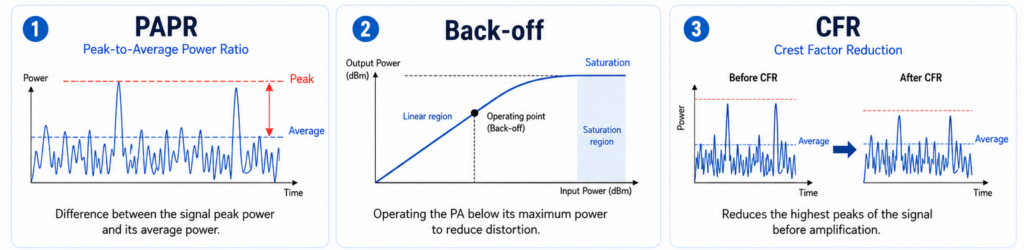
4. DPD (Digital Pre-Distortion), is a digital signal processing technique used to compensate for the nonlinear behavior of a Power Amplifier by modifying the signal before amplification.
5. EVM (Error Vector Magnitude), is used to evaluate how accurately the transmitted signal matches the expected signal.
6. ACPR (Adjacent Channel Power Ratio), measures how much power from the transmitted signal spreads into adjacent channels compared with the power in the main channel.
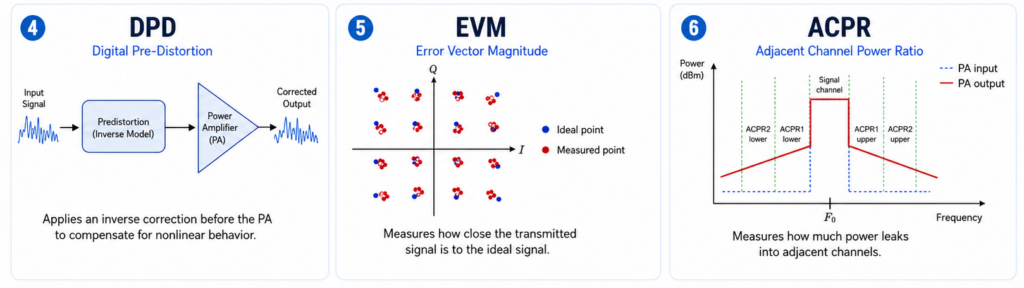
These concepts are closely connected. PAPR creates a challenge for the Power Amplifier, back-off is often used to protect signal quality, CFR helps reduce the signal peaks, and DPD helps correct the amplifier’s nonlinear behavior.
Why high-PAPR signals are difficult for Power Amplifiers
OFDM signals are widely used in 4G and 5G systems because they allow data to be transmitted efficiently over wide bandwidths. Instead of relying on a single carrier, the signal is composed of multiple subcarriers, which makes it suitable for modern high-data-rate communication systems.
The difficulty is that this type of signal can generate high power peaks. These peaks may be short, but the Power Amplifier still needs to handle them correctly. If the peaks are compressed or distorted, the quality of the transmitted signal can be degraded.
A common way to avoid distortion is to operate the amplifier with output power back-off. In other words, the amplifier is not pushed to its maximum output power, so it remains in a more linear region. This helps preserve signal quality, but it also creates an efficiency penalty.
For RF engineers, this is where the problem starts. A very linear amplifier is useful, but if it requires too much back-off, the system becomes less efficient. A more efficient operating point is attractive, but if the amplifier is pushed too close to saturation, nonlinear distortion becomes more critical.
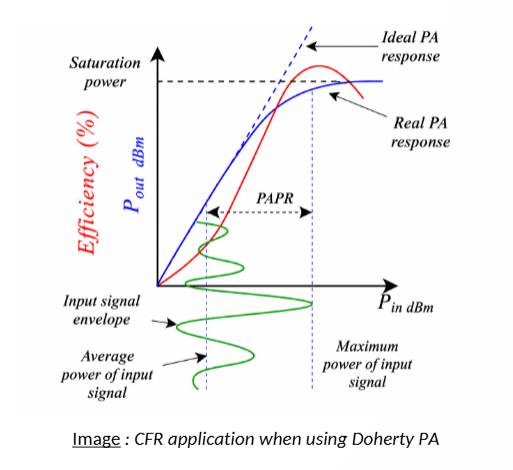
The figure below illustrates why high-PAPR signals are difficult to amplify efficiently. The amplifier must handle short signal peaks while remaining as close as possible to a linear response.
What is Crest Factor Reduction?
Crest Factor Reduction is used to reduce the PAPR of a transmitted signal before amplification. In simple terms, CFR reduces the highest peaks of the waveform before the signal enters the Power Amplifier.
This does not mean that CFR makes the amplifier linear by itself. Its role is different. CFR prepares the signal so that the amplifier does not have to handle peaks that are unnecessarily high compared with the average power level.
By reducing these peaks, CFR can help the amplifier operate with less back-off while limiting excessive distortion. This is especially useful for wideband OFDM signals, where high peaks can force the amplifier to operate far from its most efficient region.
At Wupatec, CFR techniques include clipping and filtering baseband algorithms. Clipping is used to reduce the highest peaks of the signal, while filtering helps manage unwanted effects introduced by the peak reduction process.
CFR must be carefully adjusted. If it is too aggressive, it can degrade signal quality. If it is not strong enough, it may not reduce PAPR sufficiently to improve amplifier efficiency. This is why CFR should not be seen as a basic “peak cutting” operation, but as a signal processing technique that needs to be adapted to the waveform, the amplifier architecture and the RF requirements of the system.
How CFR helps improve efficiency
Without CFR, a high-PAPR signal may require significant back-off to avoid distortion. This helps protect linearity, but it also reduces the efficiency of the Power Amplifier.
With CFR, the highest peaks are reduced before amplification. The amplifier can then operate closer to an efficient region, while reducing the risk of excessive peak-driven nonlinear distortion.
For Doherty Power Amplifiers, this is particularly relevant because the architecture is designed to improve efficiency under back-off conditions. CFR helps create better signal conditions before amplification, making the efficiency and linearity compromise easier to manage.
However, CFR does not correct the nonlinear behavior of the amplifier itself. Even after peak reduction, the PA can still introduce distortion. This is where Digital Pre-Distortion becomes necessary.
What is Digital Pre-Distortion?
Digital Pre-Distortion is used to compensate for the nonlinear behavior of a Power Amplifier. Instead of waiting for the amplifier to distort the signal, DPD modifies the input signal before amplification.
The principle is to apply a controlled correction before the signal reaches the amplifier. Then, when this corrected signal passes through the nonlinear amplifier, the output becomes as linear as possible.
A simple way to understand DPD is to think of it as an opposite correction. The amplifier introduces distortion. DPD anticipates this behavior and modifies the input signal in the opposite direction, so that the final output is closer to the expected linear response.
When properly implemented, the complete chain composed of the predistorter and the Power Amplifier behaves more linearly than the amplifier alone.
The simplified diagram below shows the basic principle of DPD: the signal is corrected before amplification so that the final output becomes closer to the expected linear response.

How a DPD loop works
A typical DPD process relies on a feedback loop. First, the output of the Power Amplifier is measured through a feedback path. Then, this measured output is compared with the input of the Power Amplifier. This comparison helps estimate the nonlinear behavior of the PA.
Once this behavior has been estimated, correction coefficients are updated and applied to the PA input. The purpose of these coefficients is to adjust the predistortion so that the amplifier output becomes closer to the expected signal.
This loop allows the system to adapt the correction to the real behavior of the amplifier. This point matters because the correction is not only theoretical. It depends on the actual amplifier response, the signal bandwidth, the feedback path and the target performance.
The objective of DPD is therefore not only to make the amplifier more linear. The objective is to maintain high linearity while allowing the PA to operate in a more efficient region.
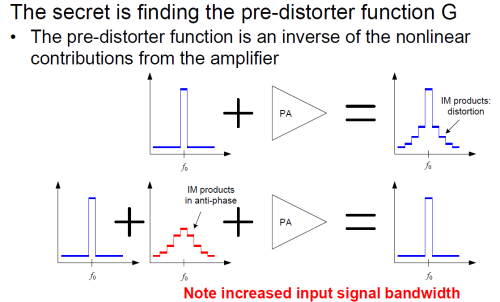
Beyond the basic feedback loop, the key challenge in DPD is to identify the right pre-distorter function. This function must compensate for the nonlinear contribution of the Power Amplifier by applying an inverse correction before amplification.
In practice, this correction can generate additional components at the input of the amplifier, designed to counterbalance the distortion created by the PA. This is why DPD implementation must be carefully adapted to the amplifier behavior and signal bandwidth.
CFR vs DPD: two complementary techniques
CFR and DPD are often mentioned together, but they do not solve the same problem.
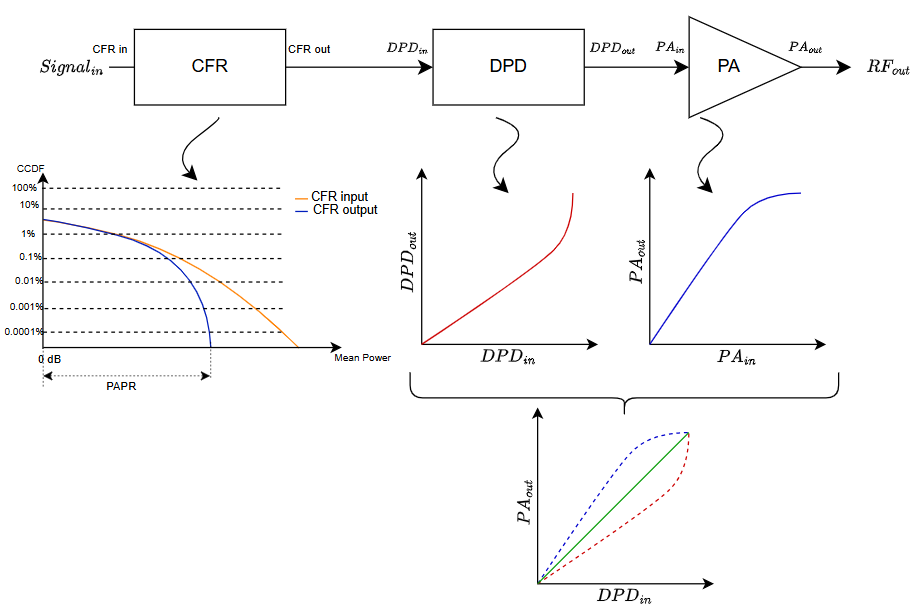
CFR acts on the signal waveform before amplification. Its role is to reduce the highest peaks of the signal and lower the PAPR.
DPD acts on the amplifier behavior. Its role is to compensate for the nonlinear distortion introduced by the Power Amplifier.
In other words, CFR prepares the signal, while DPD corrects the amplifier behavior. CFR helps improve the operating conditions of the amplifier, and DPD helps preserve linearity at the output.
Used together, these two techniques help the Power Amplifier operate more efficiently while maintaining a cleaner output signal.
The figure below summarizes why CFR and DPD are complementary. CFR helps reduce the most demanding signal peaks before amplification, while DPD compensates for the nonlinear response of the Power Amplifier. Together, they help the amplification chain get closer to the expected linear behavior.
Doherty Power Amplifiers and the efficiency challenge
Doherty Power Amplifiers are commonly used in modern wireless infrastructures because they help improve efficiency at output power back-off. This makes them particularly relevant for high-PAPR signals, which spend much of their time around average power levels while still containing occasional peaks.
However, the Doherty architecture does not remove the need for correction. When a Doherty Power Amplifier is used with wideband OFDM signals and driven closer to efficient operating regions, nonlinear effects still need to be carefully managed.
Without proper correction, these nonlinear effects can lead to signal distortion, spectral regrowth, EVM degradation, ACLR degradation and interference with adjacent channels. In a communication system, these issues are not minor details. They directly affect signal quality and spectral cleanliness.
This is why CFR and DPD are important when working with Doherty Power Amplifiers. The objective is not only to improve efficiency. The objective is to improve efficiency while keeping the amplified signal clean enough for modern communication requirements.
Wupatec’s approach to CFR and DPD
At Wupatec, CFR and DPD are integrated as part of a complete RF and digital approach. The objective is to support high-efficiency RF front-end systems, Doherty Power Amplifier architectures and modern 4G/5G radio applications.
On the CFR side, Wupatec’s techniques include clipping and filtering baseband algorithms designed to reduce PAPR while limiting excessive EVM degradation. These CFR solutions are optimized for wideband OFDM signals, Doherty Power Amplifier architectures used in modern 4G/5G systems, high-efficiency RF front-end systems, multi-carrier and wideband applications, and customer-specific RF requirements.
Wupatec’s CFR algorithm hardware IP core is currently under validation and will later be proposed as a customizable Intellectual Property core, adaptable to FPGA and ASIC platforms.
On the DPD side, Wupatec test benches can work with commercial DPD solutions, customer-specific algorithms or proprietary Wupatec DPD/CFR developments, depending on the target architecture and application constraints.
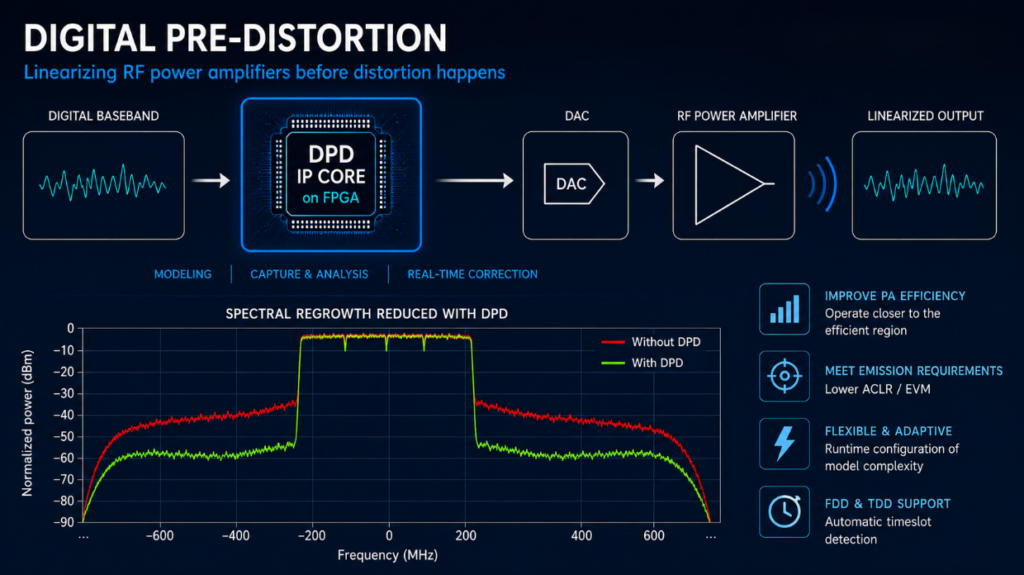
The illustration below shows how DPD can be integrated into a digital RF chain to compensate for PA nonlinearities and reduce spectral regrowth at the output.
This flexible approach allows CFR and DPD to be adapted to the system rather than treated as generic processing blocks. In RF systems, this matters because the waveform, amplifier architecture and performance targets can vary significantly from one project to another.
Conclusion
Modern 4G and 5G RF systems require both high efficiency and high linearity. This is difficult because wideband OFDM signals often have high PAPR, forcing Power Amplifiers to handle occasional peaks while maintaining signal quality.
Doherty Power Amplifiers help improve efficiency at output power back-off, but they still require proper correction when used with wideband modulated signals and efficient operating conditions.
CFR helps reduce the highest signal peaks before amplification. DPD helps compensate for the nonlinear behavior of the amplifier. Together, these techniques help RF systems operate closer to their efficiency targets while preserving the linearity required for modern communication signals.
For Doherty Power Amplifiers, CFR and DPD should not be seen as isolated techniques. They are part of the same strategy: making high-efficiency amplification usable under real signal conditions.